Into a Space Where Architecture and Art Intersect: Ryuji Nakamura and Soji Matsunobu's "Spatial Dance" to Be Held at Zuun-an in Kyoto
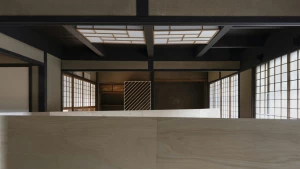
 Ryuji Nakamura and Soji Matsunobu's exhibition "Spatial Dance" will be held at Zuun-an in Kyoto from October 24.
Summary
The exhibition "Spatial Dance" by architect Ryuji Nakamura and artist Soji Matsunobu will be held at the art space Zuun-an in Kamigamo, Kyoto, from October 24 to November 23 (open only on Saturdays, Sundays, and Mondays). The exhibition focuses on the relationship between "mono" (things) and "koto" (events) in Japanese architecture, exploring the abstraction present in both architecture and art. "Mono" refers to the physical conditions such as structure and function that make up architecture, while "koto" refers to human behavior and bodily experiences that occur within the space. The exhibition attempts to reexamine the characteristics of Japanese architecture where these two elements intersect, from both contemporary art and architectural perspectives. Zuun-an is an art space utilizing traditional Japanese architecture located in Kita-ku, Kyoto, operated by the Nishieda Foundation to support young creators. Through the dialogue between Matsunobu, who has an architectural approach, Nakamura, who also works from a contemporary art perspective, and the space of Zuun-an, the exhibition questions the relationship between our perception, body, and space. Matsunobu, born in 1988 in Kumamoto and based in Shiga, stayed in France in 2023 as an overseas trainee of the Pola Art Foundation. The exhibition features works such as "Shelf" and "Dimensional box" that question the function and meaning of everyday objects. "Shelf" questions the original concept of a shelf as furniture for placing objects, and through "completed shelves" that refuse to hold objects, it highlights our perception of shelves. "Dimensional box" is a self-referential work where the interior of a box is projected like an X-ray onto an acrylic box, casting shadows and creating light and shadow in the surrounding space as a lighting device. In a Japanese house stripped of its functions and elements, these works become part of the space, and the "questions" inherent in the works expand to architecture itself, transforming Zuun-an into a critical abstract space.
(Source:美術手帖)