Examining the Encounter Between Japanese and Taiwanese Modern Art — "Contemporaneous Constellation: Stars That Shared Time, The Gaze of Art Crossing Borders" Exhibition〈Art Review〉小田原のどか
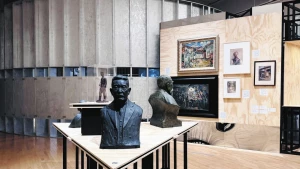
 The "Contemporaneous Constellation" exhibition at Tokyo Museum of Contemporary Art examines the relationship between Japanese and Taiwanese modern art.
Summary
The "Contemporaneous Constellation: Stars That Shared Time, The Gaze of Art Crossing Borders" exhibition currently on view at the Tokyo Museum of Contemporary Art brings together approximately 200 works from over 15 Taiwanese museums and private collections, along with around 500 pieces of documentation and roughly 100 Japanese works. This marks the first time in Japan that Taiwanese modern art has been presented on such a scale. Organized into six chapters, the exhibition features guest curator 黄亜歴 (Huang Yali), a Taiwanese-born filmmaker familiar with East Asian avant-garde art movements. The first chapter, "Between Translation and Creation," focuses on how Taiwanese modern art was established under Japanese colonial rule, centering on the Taiwan Art Exhibition (台展), which was modeled after the Imperial Art Exhibition (帝展). Among the works displayed is the sculpture "Kanrui sui" (1919) by sculptor 黄土水 (Huang Tushui, 1895–1930), the first Taiwanese student at Tokyo Fine Arts School, which has been designated a national treasure of Taiwan. Alongside works by artists who have already held solo exhibitions in Japan and important works of Taiwanese modern art are pieces by contemporary Japanese artists. The spatial design, created by an emerging Taiwanese architect unit and 黄亜歴, departs from conventional tranquil art-viewing spaces, featuring unconventional installations and an inventive presentation approach where artworks seem intricately embedded within the space.
(Source:東京新聞)