The Venice Biennale from a Queer Ecology Perspective: How Have Recent National Pavilions Responded to the Governance of Life? (Text by Maya Erin Masuda)
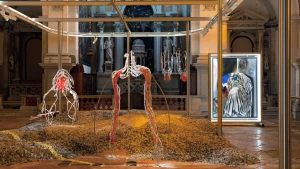
 Maya Erin Masuda examines four exhibitions, including the 2024 Venice Biennale's Lithuania Pavilion, from a queer ecology perspective on the governance of life.
Summary
This article, by artist and queer ecology researcher Maya Erin Masuda, examines four exhibitions from the 2024 and 2026 Venice Biennale international art exhibitions and the 2025 international architecture exhibition, rethinking the relationship between desire and ecology from a queer ecology perspective. Drawing on environmental humanities, trans studies, and queer theory, it considers how recent national pavilions have responded to the governance of life rooted in the control and exploitation of resources and bodies, the formation of desire under capitalization, and environmental pollution. A central focus is the Lithuania Pavilion (Pakui Hardware + Marija Teresė Rožanskaitė) at the 60th Venice Biennale (2024), exhibition "Inflammation." Referencing Rupa Marya and Raj Patel's book "Inflamed," it asks how structural social injustice is inscribed in the body as chronic inflammation. Rožanskaitė's paintings of operating and examination rooms, alongside large aluminum-and-glass nervous systems and sculptures evoking heated, swollen organs, spatially unfold and envelop the viewer's body. Pakui Hardware asks how toxicity unequally distributed along racial gradients (air and water pollution) is experienced as pain inside the body, while the recycled-plastic dunes suggest one cannot posit an "outside" to pollution or an innocent position detached from it. Citing Mel Y. Chen's "Animacies," the article notes how lead discourse racialized exposure—only certain bodies' exposure was framed as threat while others were rendered invisible. The exhibition dissects not "planetary pain" but bodies exposed to "environmental injustice."
(Source:Tokyo Art Beat)