Opening the Backstage of the Collection: What is the Centre Pompidou's New Facility, "Francilien Fabrique de l'Art"?
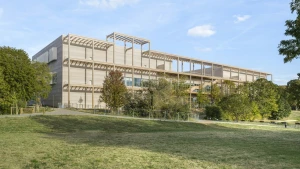
 The Centre Pompidou's new facility integrates storage, restoration, and exhibition to open the backstage of its collection.
Summary
The collection of the Musée National d'Art Moderne originated in 1818 and moved to the Centre Pompidou in 1977, expanding to include photography, video, architecture, and design, now holding about 150,000 works. These works were previously stored in eight locations around Paris, with staff for management and conservation scattered. The new facility, "Francilien Fabrique de l'Art" (Centre Pompidou Francilien), aims to centralize storage, research, restoration, packing, transport, and exhibition preparation. Designed by PCA-STREAM, the building combines closedness to protect artworks with openness to the community. Its beige concrete walls have a double structure to buffer temperature changes, and a public area features a wooden three-story corridor and zigzag staircase connecting exhibition rooms and a rooftop viewpoint. The building is based on a 9-meter cube grid for flexibility. Storage and restoration workshops occupy about 60% of the floor area, with doors color-coded by function: red for storage, green for restoration, blue for packing, yellow for artwork management, and gray for logistics. This facility aims to transform museum operations by uniting collections and specialized staff expertise in one place.
(Source:美術手帖)