How Was Escher's "Infinity" Born? "Escher: How to Make Infinity" Traces His Creative Path Through Some 200 Works, Opening in 2027
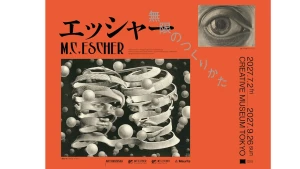
 An exhibition tracing Escher's creative path through about 200 works, including masterpieces, will open in 2027 in Tokyo, Osaka and other cities.
Summary
An exhibition titled "Escher: How to Make Infinity" will trace the creative path of Maurits Cornelis Escher (1898–1972), who depicted worlds that cannot exist in reality, such as geometric repeating patterns, optical illusions and impossible architecture. The Tokyo edition will be held at CREATIVE MUSEUM TOKYO in Kyobashi from July 2 to September 26, 2027. Escher was born in the Netherlands and, after studying at the School of Architecture, Decorative Arts and Crafts in Haarlem, devoted himself to printmaking. During the 1920s and 1930s he stayed in Italy, producing works based on landscapes and architecture. He was strongly influenced by the decorative patterns of the Alhambra in Spain, and especially after revisiting it in 1936 he developed his "plane-filling" (tessellation) expressions, in which figures fill a flat surface without gaps. The exhibition presents about 200 works, including masterpieces, from the vast collection of the M.C. Escher Foundation, tracing the evolution of his creation from early landscape and architectural expressions to the "infinity" and "impossible space" expressions developed through his interest in mathematics and geometry. Escher's works, which fuse highly skilled printmaking techniques such as woodcuts and lithographs with mathematical thinking, have influenced a wide range of fields beyond art, including architecture and design. The exhibition also sheds light on the sources of the thinking behind these original visual expressions. After the Tokyo venue, the exhibition will travel to the Abeno Harukas Art Museum in Osaka from October 9 to December 8, 2027, with plans to also hold it in Nagoya and Shizuoka in 2028.
(Source:美術手帖)