Yu Tsukada | "Superman" MV (Director: Mugi Hashimoto)
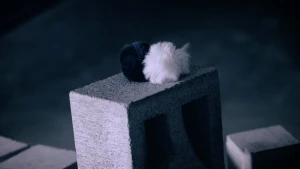
 Mugi Hashimoto's "Superman" MV is a masterpiece that maximizes the fundamental appeal of animation through the collaboration of stop-motion and a custom system.
Summary
This article is a review praising Mugi Hashimoto's "Superman" MV (2026), which will be screened at the 13th New Chitose Airport International Animation Festival (November 20–24, 2026). Hashimoto is known for his "making the way of making" approach, starting from tool development, and this work maximizes the fundamental appeal of animation—"things moving." Set in an indoor space with exposed concrete, white and black fluffy balls and insulators used for utility poles are anthropomorphized and move freely through the space alongside steel pipes and concrete. Hashimoto scaled up his past stop-motion work "Fly feat.79, Nakamurа Kaho" MV (2017) and created this piece using a custom system that visualizes the camera's trajectory in 3D space in real time as a feedback and recording system for subsequent shooting. The slight resistance of the hand-operated camera contributes to the strength of the animation, and traces of this are left throughout the screen. By deliberately not hiding such "devices" as clay fixing the positions of rolling insulators and threads suspending the balls, the reality of the movement comes across as a sense of wonder. There are also many scenes that stimulate interest in the making process, such as the undulating ground at the beginning and the concrete that repeatedly splits after one minute appearing to become papercraft as it shrinks. Hashimoto describes his style of moving back and forth between handwork and programmatically constructed systems with the words "chima" and "gene." "Chima" is the accumulation of painstaking work, and "gene" is the generative operation of a system. His work is completed through the collaboration of both, and this attitude is also a counter to the modern era in which all phenomena are becoming automated due to the rise of AI. Hashimoto's work, which sublimates such human mannerism into imagery, resonates with the lyrics "Praise this incomplete me" while enriching the interpretation of the song by multiplying the two balls in accordance with scenes, in contrast to the phrase "The world is just the two of us staring at each other" which evokes a two-person relationship. To explain his approach to production, Hashimoto talks about the "fitness landscape" derived from evolutionary biology. This is a model in which "the genotypes of organisms are placed on a coordinate plane, and the 'fitness'—how well they can survive and leave offspring under those conditions—is represented as height," and "biological evolution is depicted as a process in which the population gradually moves across this landscape toward higher places, that is, points of higher fitness." In this model, multiple organisms—mountains—each aim for higher points, and unique forms are created through relationships among various conditions. Using this as an example, Hashimoto states that there are many ways to climb the "peak of 'goodness,'" and within himself, this "fitness landscape" model connects to visual techniques, cultural views, and social views. In this metaphor, just as James Stuart Blackton, one of the pioneers of animation, surprised audiences in "The Haunted Hotel" (1907) by filming furniture that should not move using stop-motion, Hashimoto achieved it using balls, concrete, and other objects. That "peak of 'goodness'" is a slightly different route from Blackton's peak. However, the "Superman" MV draws out the potential of animation as a medium to the fullest, to the extent that one wants to cite such historical examples. Beyond this climbed peak, what horizons of expression will Hashimoto open up in the future?
(Source:artscape)