【Dialogue】Ann Veronica Janssens × Hideaki Kawabata: Opening Our Cognition through Light and Space. A Conversation Between an Artist and a Scientist
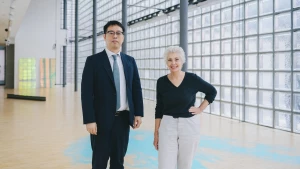
 Artist Ann Veronica Janssens and cognitive scientist Hideaki Kawabata discuss perception, space, and cognition in dialogue.
Summary
Belgium-based artist Ann Veronica Janssens is holding her first solo exhibition in Japan, "Tokyo, Ginza 5-4-1," at Ginza Maison Hermès Le Forum (until January 11, 2027). Since the late 1970s she has used simple materials like plywood and glass, and since around 1990 has incorporated light, sound, and artificial mist into experimental works. Her practice spans sculpture, installation, video, photography, and stage design, consistently exploring bodily perception and the ambiguous realms of cognition. She is also known for interdisciplinary work, including co-founding the Brain Space Laboratory, where artists and scientists investigate relationships between space, time, body, and brain. For this exhibition, Hideaki Kawabata (Professor at Keio University), a researcher in affective science and cognitive neuroscience, visited the venue and engaged in a dialogue with Janssens. They discussed art and science, brain and perception, and ways of grasping space from both artistic and scientific perspectives. Janssens explained that based on her direct experience of the venue's structure, light, air, and temporality, she selected works whose mediums are intangible and cannot be held. Kawabata touched on contingency and serendipity, and cited his mentor, neuroscientist Semir Zeki of University College London, who said that "great artists are great neuroscientists," highlighting artists' foresight. Janssens stated her aim is to activate the viewer's cognition itself through her works.
(Source:Tokyo Art Beat)