Harachikei | the lives of ephemeral form: Recording the Uncertain Life of Architecture
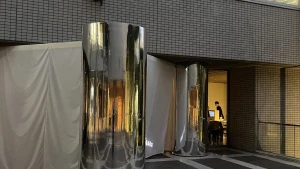
 An exhibition exploring architectural archiving methods through films and materials, starting from the uncertainty of architecture and records.
Summary
This exhibition is a program that explores methods of architectural archiving together with exhibitors, starting from the dual uncertainty of architecture and records. Against the backdrop of buildings being altered and eventually lost, and their records similarly subject to deterioration and the disappearance of playback environments, the exhibition publicly presents the processes of film screenings and material organization, attempting to expand the scope of records to include life and activities that are difficult to capture in completion photographs or drawings. Toshio Matsumoto's film "The Lives of Ephemeral Form: Pasadena Heights" (1974) is a promotional film following "Community Life" (1972), which filmed the model stage of Kiyonori Kikutake's housing complex. In the film, people appear in a blown-out white screen and disappear when exposure returns; in a scene set in an office corner of the building, Kikutake himself plays the role of the architect, pointing to models and drawings. The distinctive narration expressing hope for future living—"It is a city that never was, a city yet unseen" and "Everyone is a protagonist, a director, and at the same time an audience"—is layered with unsettling music by Toshi Ichiyanagi, and the newly completed building is shown as if it were already a ruin abandoned by people. The gap between the words introducing the Metabolist housing plan and the images and music presents the conceived form of collective living as a performance, coexisting future urban life with architectural decay. Whereas Matsumoto's film performs life in a future urban dwelling, the survey materials of Itsuko Hasegawa and Architectural Planning Office, selected by Michino Aoyama, question how to archive the vast accumulation of materials stored by the office and make them publicly available information. While drawings, models, and photographs are being organized on occasions such as exhibitions, primary materials that are difficult to visualize—planning materials, survey photographs, and videotapes—are made public. Among them, the recorded footage of the Niigata City Performing Arts Center, which opened in 1998, and materials related to workshops prepared by staff and citizens record the conditions under which architecture continues to be used in parallel with construction. The recruitment materials (1994) for the N-PAC workshop planned during the design of the Niigata City Performing Arts Center call for the training of curators, artistic directors, and stage staff. In an essay titled "Making a Public Hall Is Also Making People," Hasegawa argues that architectural evaluation only has meaning when accompanied by citizen activities and preparation for operation, and advocates the need to create "software" programs that foster excellent communication spaces raising citizens' awareness of participation, and to nurture people who can fully use the space. This group of materials displayed on tables was an attempt to trace such practices as records, which are difficult to see from completion photographs representing the "hardware" of the building. Yu Shinoda's work connects photographs of two Meiji University school buildings designed by Sutemi Horiguchi and later demolished, composing a single building that does not exist on video. Each photograph points to a place that actually existed, but no architecture corresponds to the connected space, and the relationship between record and subject is rearranged through re-editing. On the adjacent screen, words extracted from the script of "The Lives of Ephemeral Form: Pasadena Heights" appear, and photographs and words derived from different buildings reconfigure the image of a place in new relationships. The screening program also includes "Poem of Stone" (1963), which reworks Ernest Satow's photographs of a quarry into video, and "Engram = Memory Trace" (1987), which uses video cut-ups to explore memories whose existence is uncertain, offering clues for considering this operation. The possibility of rereading opens only when records are kept in a viewable state. In his displayed notebook, Takehiko Kanemaki points out the paradox that temporary productions like flyers, if named "ephemera" and preserved, escape the fate of disposal but simultaneously cease to be temporary. The materials of "The Lives of Ephemeral Form" are also collected by the National Film Archive of Japan, and rereading of the preserved records becomes possible only when the technology to play the video, the circumstances of production, and the context in which it was handled are also inherited. Therefore, the re-editing of records and the reviews present here also rest on such accumulations. The significance of this exhibition lies in making viewers read what kinds of activities support architecture and through what kind of editing they come into focus. By placing materials in a state where viewers can examine even their provenance and arrangement, the exhibition is conscious of not allowing rereading to conclude as a one-time event. How to pass on to the next person the process of selecting, recording, and editing materials was open to verification from multiple directions. What is questioned here is the methodology of archiving, which is not only about recording the uncertain life of architecture but also about continuing to engage with the uncertain life of records themselves.
(Source:artscape)