Report on the Opening of "Yuasa Eoboshi and the Postwar Avant-Garde Metamorphosis Fable Collection" (Nerima Art Museum): What Is Born When a Fictional Painter Meets Postwar Avant-Garde Art?
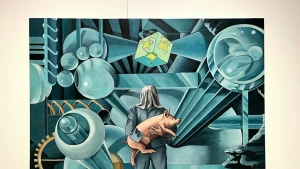
 The Nerima Art Museum's exhibition of Yuasa Eoboshi juxtaposes works by a fictional painter with postwar avant-garde art, exploring the boundary between fiction and reality.
Summary
The exhibition "Yuasa Eoboshi and the Postwar Avant-Garde Metamorphosis Fable Collection" opened on October 31 at the Nerima Art Museum in Nakamurabashi, Tokyo, and runs until December 27. It is curated by museum curator Kinoshita Sayako. Yuasa Eoboshi, born in 1983, creates paintings based on collages of old images collected from newspapers, magazines, and the internet. Since around 2017, he has called himself the "Mimicry School" and has presented paintings based on the persona and life of a fictional deceased painter, "Yuasa Eboshi" (1924–1987), a third-rate painter supposedly born in the Taisho era. The exhibition has three sections. Chapter 1 presents Yuasa's works in chronological order of his own production, with captions in which Yuasa explains the works of "Yuasa." The fictional painter's profile includes: born in 1924; gave up oil painting due to an allergy to volatile oils; made collage works using magazine illustrations during the war; after the war worked as a portrait artist for the occupation forces and joined the Avant-Garde Art Association; moved to the U.S. in 1956, washed dishes in New York while collecting magazines and newspapers, and encountered abstract painting and acrylics; after returning to Japan developed a unique "imported transcription style" blending American culture, Surrealism, and reportage painting; received an honorable mention in the 1964 Shell Art Award; became a recluse in later years and died in 1987 at 63 from severe burns sustained trying to rescue works from a house fire. Because the display follows Yuasa's chronological order rather than "Yuasa's," there is an inversion in which works supposedly painted earlier show greater technical skill than later ones. Yuasa seems less interested in realistically constructing the fictional painter's technical history than in separating painter from painting to emphasize the oddness and uncanniness of the images themselves. The captions analyze "Yuasa's" works against historical backgrounds; for example, "Blue Sky" is interpreted as depicting child labor as a metaphor for wartime mobilization, though the validity of such readings is left open. In later sections, a poetry collection by the fictional poet Kiryu Toichiro—actually written by novelist Ogawa Tetsu—is displayed in dialogue with "The Puppet King," which allegorizes Japan-Manchukuo relations during the Second Sino-Japanese War, layering fictional narratives upon fictional histories to stimulate the viewer's imagination.
(Source:美術手帖)