Takashima Yasushi|10 Cashiers, Supermarket Sounds, an Opera for Piano: Lithuanian Contemporary Opera Performance "HAVE A GOOD DAY!"
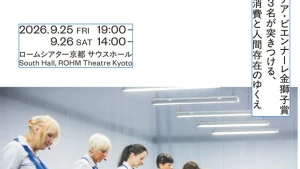
 A review of the Lithuanian contemporary opera performance "HAVE A GOOD DAY!" by three women artists, depicting capitalist structures through the chorus and arias of 10 cashiers.
Summary
The contemporary opera performance "HAVE A GOOD DAY!" by Lithuanian artists Vaiva Grainytė (libretto), Lina Lapelytė (composition), and Rugilė Barzdžiukaitė (direction) was staged at Rohm Theatre Kyoto South Hall on September 25–26, 2026. As the subtitle "10 Cashiers, Supermarket Sounds, an Opera for Piano" indicates, the work consists of choruses and solo arias sung by 10 women cashiers, accompanied only by barcode-scanner electronic beeps and piano—a minimalist structure that excludes traditional operatic elements such as privileged "soloists," tragic narratives, and orchestras. It premiered in 2013; the same trio's opera performance "Sun & Sea" won the Golden Lion at the 2019 Venice Biennale.
On stage, 10 identical white platforms are arranged in a row. Even before the performance begins, the 10 women seated on chairs keep scanning printed barcodes, and the mechanical "beep beep" of the scanners quietly resonates. The women, of various ages, all wear blue aprons as "uniforms," and evenly spaced fluorescent lights cast a cold, inorganic glow. What is displayed here is not a glamorous consumption space overflowing with enticing goods, but the capitalist structure itself—homogenizing and standardizing everything, forcing women without regular employment to sell low-wage labor as a "commodity." Their bodies, subjected to emotional labor, are also objects of a sexualized gaze.
The piece opens with a "lullaby" sung by one cashier. Eggs wrapped in calcium clothes, insomnia-suffering yogurt, beer and wine shelves where war continues, fresh produce proud of never being discounted—the lyrics poetically personify supermarket products: "Rest well, commodities, stock clerks, cashiers." We, the audience, are also potential commodities—classified on shelves, managed by numbers, priced, discounted before the "expiration date," and discarded if unsold. The subsequent chorus repeats the customer-service formula "Welcome! Thank you! Please come again (HAVE A GOOD DAY)!" (translated into Japanese with a paraphrase since the phrase is unfamiliar). The same formula is sung at different pitches, creating harmony in which differences within homogeneity stand out acoustically.
After this introduction, each cashier—normally not allowed an "individual face" and whose "personal voice" goes unheard—monologizes her circumstances and inner life through her own aria. An immigrant woman sings, "The manager can't pronounce my name, and I can't pronounce his," and cannot return home to see family because holidays differ from her homeland. A single mother must take the first bus to arrive by the 8 a.m. opening and cannot care for her child in the morning; both leaving and returning, the sky is always dark. A woman is persistently harassed with sexual remarks by male shoppers. A highly educated working poor woman with a master's in art studies cannot find work using her specialty and grows anxious and isolated, wondering, "Should I apply for a PhD?" The remaining nine accompany each "individual" voice.
Folk-like melodies occasionally intermingle, and the frequent refrains convey the repetition of monotonous daily labor and the unchanging nature of the dominant structure. Income from long hours of low-paid work is absorbed by consumption. To work taking the 5:20 first bus, coffee alone is not enough, and energy drinks are needed daily. The month-end salary disappears into temporary comforts like movies and shopping. Drinks are often spilled on clothes, and cheap detergent cannot remove the stains, so sale-priced clothing must be bought. The repeated sales pitch "Buy this and your health and life will improve" binds oneself like a curse. Healing an aching body and accumulated stress requires new consumption, trapping them in the structure where "we are forced to labor in order to shop at the supermarket and keep the consumption cycle turning." In the sense that they are merely "parts to keep the giant gears of capitalism turning," there is no difference among them. In this work, the absence of hierarchy among the 10 cashiers is both a salvation and a stronger indication of despair. The operatic class system of "soloist monopolizing arias / supporting roles and chorus" is dismantled. Meanwhile, the fact that all are reduced to the same "hourly wage" is visualized by the flat white platforms. In the finale, the full chorus of "Welcome! Thank you! Please come again (HAVE A GOOD DAY)!" returns, driving home that capitalism's structure has neither end nor exit.
However, in 2026, many supermarkets and large retailers have introduced unmanned self-checkouts, and the sight of "cashiers" lined up is becoming rare. The work premiered in 2013, and I felt not only the universality of the dominant structure but also the speed of capitalism's acceleration and the need for updates.
Finally, in this work titled "opera," despite the absence of a "conductor," the 10-member chorus breathes in perfect unison. The invisible "conductor" controlling and directing their voices and bodies is the immense force of capitalism, and the work paradoxically exposes the ubiquity of that domination through absence.
Date of viewing: September 26, 2026 (Saturday).
(Source:artscape)