Lesson 10: "Gold Ground" — How Eastern and Western Painters Used Gold [Professor Naoki Sato] Art Appreciation Lessons Taught at Tokyo University of the Arts: A New Art History through East-West Comparison
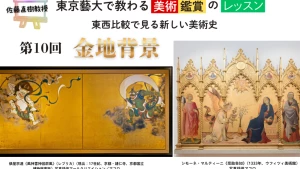
 Professor Naoki Sato of Tokyo University of the Arts compares Christian painting and Japanese folding-screen painting to show how gold was used differently in East and West.
Summary
This article is the tenth installment of the series "Art Appreciation Lessons Taught at Tokyo University of the Arts: A New Art History through East-West Comparison," a collaboration between the magazine Chuo Koron and the art exhibition site Bijutsuten Navi. Naoki Sato, a professor in the Faculty of Fine Arts at Tokyo University of the Arts, takes "gold ground" as his theme and compares how painters in East and West used gold. Since ancient times, gold has been valued not only as a symbol of wealth and power but also, because of its strong reflectivity, resistance to tarnish, and rarity, as a material expressing eternity and transcendence in both East and West. Yet even with the same material, Western art tends to foreground gold's materiality, whereas Japanese art tends to use gold for spatial expression. This contrast appears clearly in Simone Martini's Annunciation (1333, Uffizi Gallery) and Tawaraya Sotatsu's Folding Screen with Wind God and Thunder God (17th century, Kennin-ji, Kyoto, on deposit at Kyoto National Museum). In the Annunciation, while the gold ground suggests infinite space, the halos and even the archangel Gabriel's words are built up three-dimensionally in gold, enhancing the altarpiece's material value. In Sotatsu's screens, by contrast, fields of gold with no mountains, sea, or horizon feel, precisely because nothing is painted there, like the vast sky through which the wind and thunder gods race, and the large empty center evokes the invisible presence of wind and thunder. In Sotatsu's Bugaku Dancers screen, too, gold ground works as space enveloping the figures. Even in Japan gold was a luxury material indicating authority and wealth, but within painting its materiality was often restrained to establish ma, or meaningful emptiness. Martini's gold thrusts forward as a brilliant, carved object, while Sotatsu's gold expands inward through unpainted emptiness. Here one can see a vivid difference in how East and West used gold. The article ends with a brief biography of Sato, his books, and information about the November 2026 issue of Chuo Koron and a related publication.
(Source:美術展ナビ)