「100th Anniversary of Birth: Painter Makino Kunio, Who Lived Through the Showa Era - Summoning of the Soul -」 (Chigasaki City Art Museum) Venue Report: What Did the Painter, Who Mastered Overwhelming Realistic Expression, Continue to Paint?
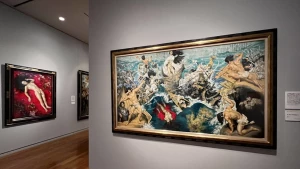
 The Chigasaki City Art Museum is hosting an exhibition commemorating the 100th anniversary of painter Makino Kunio's birth.
Summary
The Chigasaki City Art Museum in Kanagawa Prefecture is currently hosting an exhibition titled '100th Anniversary of Birth: Painter Makino Kunio, Who Lived Through the Showa Era - Summoning of the Soul -' to commemorate the 100th anniversary of the birth of painter Makino Kunio (1925-1986). The exhibition, which runs until June 7, is supervised by Yuji Yamashita, a professor of art history at Meiji Gakuin University, and curated by Yuki Kozawa, a curator at the museum. Born in Shibuya, Tokyo, Makino enrolled in the oil painting department of Tokyo School of Fine Arts (now Tokyo University of the Arts) in 1943, studying under painters Ihara Ujiro and Yosonai Sotaro. However, in 1945, he was conscripted into the military. After the war, he returned to school and graduated. He then moved from Odawara to Chigasaki to help run the 'Maccall Dressmaking Academy,' which was operated by his older sister. While continuing to create art, he also supported the academy's operations. Makino's self-portraits, including 'Self-Portrait in a Crowd' (1979), 'Self-Portrait in a Room' (1976), and 'Warped Dining Table' (1982), are on display. Although Makino's name may not be immediately familiar, he continued to create works independently after graduation, never joining any art circles. In the post-war art world, where many young artists were drawn to Western modern art, Makino admired 17th-century Dutch painter Rembrandt and pursued his own realistic expression. As a result, while his works are not widely collected by museums, they have been collected by passionate private collectors. This exhibition, which originated from a retrospective held in 2013 at the Nerima City Art Museum, is a large-scale event commemorating Makino's 100th anniversary. Featuring works from private collections, it reflects on Makino's artistic career during the tumultuous Showa era and delves into his enigmatic persona.
(Source:美術手帖)