Kotaro Sano | When Imagination Becomes Infrastructure: Liam Young's "In Other Worlds"
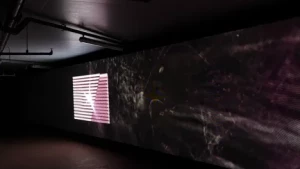
 A critical essay on Liam Young's Barbican exhibition, reading it through the lineage of speculative design and the difficulties of implementation.
Summary
This essay is a review by Kotaro Sano, who runs an algorithmic design business, of "In Other Worlds," London-based Australian filmmaker and speculative architect Liam Young's first major UK solo exhibition at the Barbican Centre. The exhibition comprises six "worlds"—Emissary, World Machine, After the End, Planet City, The Great Endeavour, and Future Present—with film, urban models, costumes by Ane Crabtree, graphic novels, and soundscapes arranged along a single route from The Curve gallery to the working Car Park 5. Taking as its axis the statement "At this scale, imagination is not decoration. It is infrastructure," the essay traces two lineages: speculative and critical design (SCD) stemming from Anthony Dunne and Fiona Raby, and architectural worldbuilding from Archigram's Walking City to Young's think tank Tomorrow's Thoughts Today and research studio Unknown Fields. Sano argues the preconditions of speculation have fundamentally changed: generative AI has devalued speculative imagery, pushing value toward the coherence of world settings, while the rise of hyperscalers has shifted the object of fear to "technologies too large to see." He notes that where Machine Landscapes offered diagnosis of a post-anthropocene world, the exhibition presents prescription, most clearly in Planet City, where humanity's greatest construction is the land left unbuilt. In the Future Present section, real documentary footage of Climeworks is placed directly after the fictional planetary carbon-removal infrastructure of The Great Endeavour, retroactively reframing the fragile startup as the first chapter of a planetary-repair narrative. Sano criticizes this for washing away the frictions of implementation—Climeworks cut roughly 20% of staff in 2025 and its plants have fallen far short of designed capacity—yet he refuses to treat this as a failure, valuing the scale of the bet in abandoning the safe 2010s gesture of posing questions from a distance. Young's method, he argues, is like film pre-production, and what is needed now is the design of the next phase—shooting—connecting speculation to implementation. Finally, he reads the bodily sequence through the brutalist Barbican itself as a spatial staging of what it means for imagination to have become infrastructure.
(Source:artscape)