"Minami Tada: Light, Swaying with Resolve" Opens at the Museum of Contemporary Art Tokyo — A Report on the 70-Year Trajectory of Sculptural Expression in Dialogue with Materials, Pursuing "Light"
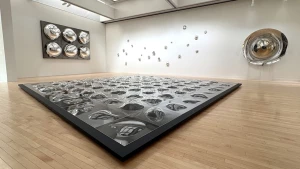
 The Museum of Contemporary Art Tokyo opens the first major posthumous retrospective of Minami Tada, tracing 70 years of her creative journey pursuing "light" through dialogue with materials in a 1,500-sqm underground gallery.
Summary
The Museum of Contemporary Art Tokyo in Kiyosumi-Shirakawa has opened "Minami Tada: Light, Swaying with Resolve," the first major posthumous retrospective of Minami Tada (1924–2014). The exhibition runs through December 6 and is curated by museum curators Hikari Kotaka and Mariko Tamura.
Born in 1924 in Takao (present-day Kaohsiung), Taiwan under Japanese rule, and raised in Korea, Tada graduated from the Women's Art School (now Joshibi University of Art and Design) in 1944. She submitted oil paintings to the Nikaten and Yomiuri Indépendant exhibitions, and in 1957 created the relief "Coal Mine" (Tanrō) for the entrance of the National Union of Coal Mine Workers' building, marking the origin of her spatial expression integrated with architecture. Against the backdrop of Japan's high economic growth period, she actively incorporated industrial materials and processing techniques into artistic expression, establishing a unique practice that integrates light reflection, transmission, refraction, and fluctuation into her works. Over her lifetime, she produced approximately 200 sculptures and more than 500 architecture-related works, leaving pieces not only in museums but also in parks, stations, city halls, hotels, and theaters across urban spaces.
The exhibition uses approximately 1,500 square meters of underground gallery space and an adjacent outdoor area, arranging around 70 works chronologically from early oil paintings to late three-dimensional works. The 1950s "Substation" series already pursued expression embedding "light" through bold black lines and layered whites. From the 1960s onward, Tada shifted to bronze, aluminum, and acrylic resin, employing unique techniques using hammers and burners to eliminate painterly habits. "Phase-Space 6943" (1969) is a mirror-like work created by applying aluminum vapor deposition to molded acrylic, reflecting viewers and surrounding landscapes. "Auto-Synchronous" (1973/2026) consists of 100 transparent acrylic forms resembling soap bubbles, faithfully reproduced for this exhibition by the Minami Tada Research Institute using original molds. The institute, currently operated by Yachiyo Iwamoto, Katsumi Watanabe, and Mitsuaki Honma, played a major role in the recreation and reconstruction of past works for this exhibition.
(Source:美術手帖)