Opening Commemorative Lecture: Mel Chin (Related Event for "The 12th Hiroshima Art Prize Commemorative Exhibition: Mel Chin")
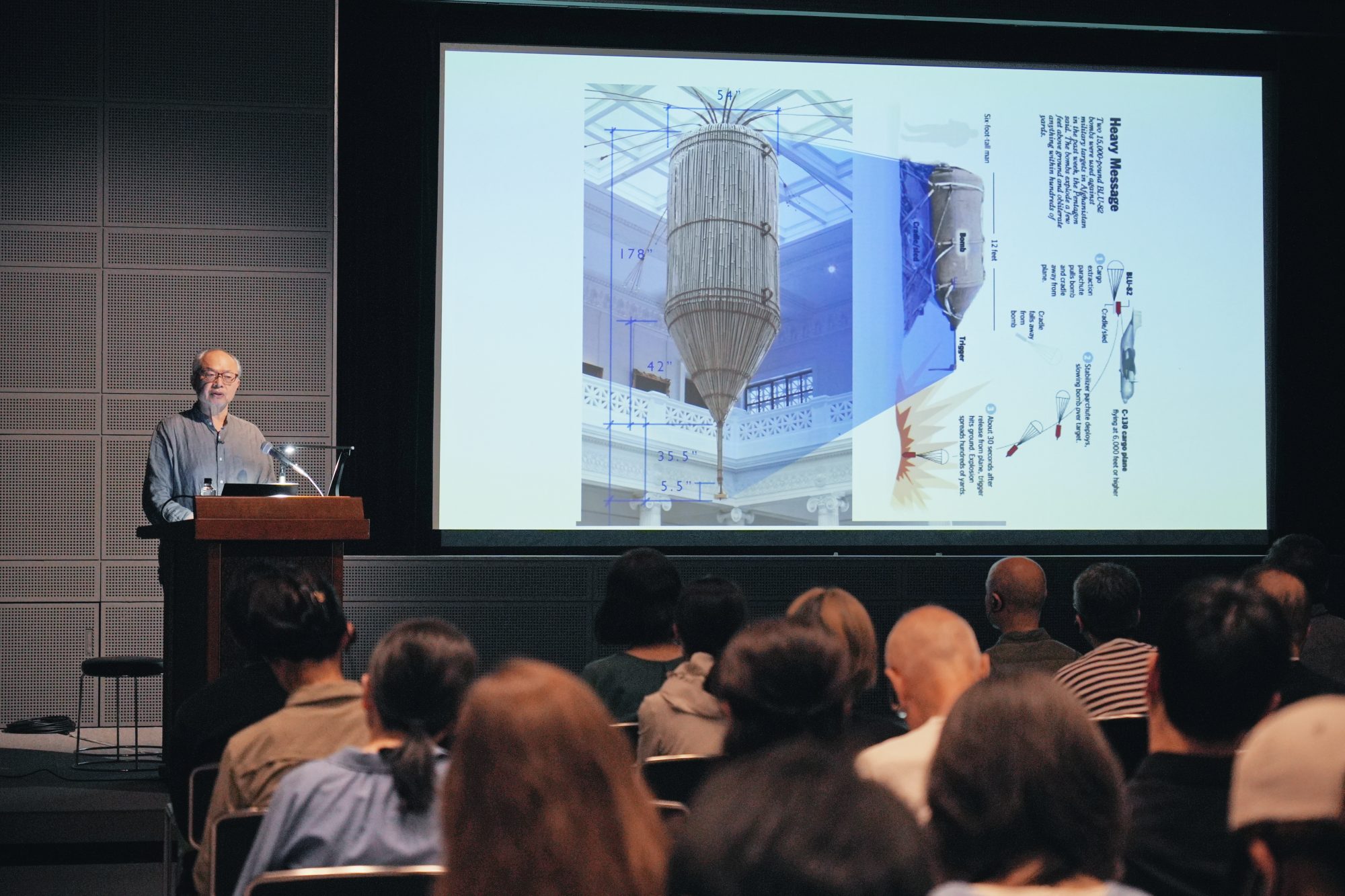
 Mel Chin spoke about the ideas behind his works at the opening lecture for his Hiroshima City Museum of Contemporary Art exhibition.
Summary
This article presents an edited and translated transcript of the opening commemorative lecture held on July 25, 2026, at the Hiroshima City Museum of Contemporary Art in conjunction with "The 12th Hiroshima Art Prize Commemorative Exhibition: Mel Chin." Rather than explaining his works chronologically, Chin began from the fundamental ideas underlying his practice, discussing works from his early career to new pieces made for Hiroshima, interweaving anecdotes and quotations. He opened with the story behind "Lecture Axe" (1988), recalling his first lecture in New York, and cited Kafka's statement that a book must be an axe for the frozen sea within us, as well as Elaine Scarry's "The Body in Pain" and its Homeric image of an arrow carrying "black pain" as cargo. This led to his central point that endowing objects with ideas is the key to his work. He then discussed "The Shape of a Lie" (2006), describing the ascent of a small truth propelled by sexual force, checked by the stomach as a "second brain," yet ultimately expelled through the tongue, and connecting its catlinite material to broken treaties with Native Americans. "Bat and Dove" (2007) addressed opposing interpretations and ambiguity, with Chin asserting that the question belongs to the viewer. "Cross for the Unforgiven" (2002), made from eight AK-47s welded into a cross, examined how symbols shift allegiances between power and faith. "Carolina Turtle (Hillbilly Armor)" (2005) was inspired by Donald Rumsfeld's remark that "you go to war with the army you have" and by soldiers' makeshift armor against IEDs, leading Chin to research the Tennessee box turtle and the Humvee. Finally, "Our Strange Flower of Democracy" (2005) is a bamboo replica of a Daisy Cutter bomb, topped with hemlock, prompted by U.S. propaganda leaflets dropped during the Gulf War reading "Flee and live. Stay and die."
(Source:ART iT)