Episode 6: 'Mist' [Professor Naoki Sato] Art Appreciation Lessons at Tokyo University of the Arts: A New Art History Viewed Through East-West Comparison. A Space to Calm the Mind or a Fear of the Unknown?
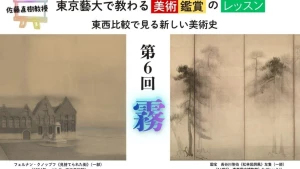
 Professor Naoki Sato compares the works of Hasegawa Tohaku and Fernand Khnopff to explain the differing perceptions of 'mist' between East Asia and the West.
Summary
Professor Naoki Sato of Tokyo University of the Arts explores the contrasting perceptions of 'mist' between East Asia and the West by comparing the works of Hasegawa Tohaku and Fernand Khnopff. While mist is often viewed in Japan as an emotional and fantastical element that brings a sense of tranquility, Sato notes that in the West, it is frequently described as an ominous symbol that obscures vision and hints at death. He analyzes Hasegawa Tohaku's masterpiece, the 'Pine Forest Screen' (Shorinzu Byobu), a 16th-century Japanese ink painting that uses the gradation of ink to create a soft, immersive space that invites meditation. In contrast, Khnopff's 'The Abandoned City' (1904) depicts a misty, eerie scene filled with negative imagery such as empty plinths and encroaching water, evoking a sense of loss and unease. Sato argues that this difference stems from the physical reality of mist in Western life, where it often poses a tangible threat to visibility and safety, whereas in Japan, it has long been cherished as a seasonal and aesthetic presence.
(Source:美術展ナビ)