Udyl Group x Cultural Heritage Utilization Center Refreshes Tokyo National Museum's 'Gateway to Japanese Art' with 'Once-in-a-Lifetime' Viewing Experience
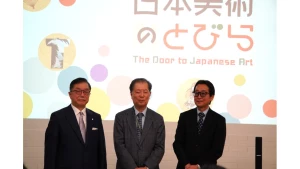
 Udyl Group has refreshed the Tokyo National Museum's 'Gateway to Japanese Art' exhibition space with an interactive video content called 'Tokyo Wonderwall (Once-in-a-Lifetime)' that introduces masterpieces currently on display in real-time.
Summary
Udyl Group, a corporate group specializing in spatial design and educational content for museums, libraries, and educational facilities, has been involved in the renovation of the 'Gateway to Japanese Art' exhibition room on the first floor of the Tokyo National Museum's main building. At the space, which opened on June 30, 2026, Udyl Group produced the interactive video content 'Tokyo Wonderwall (Once-in-a-Lifetime)'. Utilizing a large screen 14 meters wide, the content leverages approximately 120,000 items in the Tokyo National Museum's collection. Connected to the National Institutes for the Humanities' integrated search system 'ColBase', it selects and introduces masterpieces from the approximately 3,000 works actually on display that day in real-time. Visitors encounter works through a screen that reads their body movements via motion sensors, making it accessible to everyone from small children to wheelchair users. The display supports four languages: Japanese, English, Chinese, and Korean. With six themes such as 'Meet a researcher's favorite' and 'Meet a National Treasure or Important Cultural Property', the content reflects the specialized knowledge of over 50 researchers at the Tokyo National Museum. The aim is to deliver encounters with masterpieces on display that day in different forms to each visitor, heightening their anticipation for the exhibition room. Udyl Group oversaw the entire project, with development handled by its group company Powerplace Co., Ltd., Udyl Group Co-creation System Design Team, and Ubiquitous Library. The Cultural Heritage Utilization Center of the National Institutes for the Humanities served as the planning and production entity. The Tokyo National Museum provided the facility and collaborated with researchers, reflecting the institution's research results in the experiential design. The Cultural Heritage Utilization Center conceived the content based on visitors' needs, noting that while only a portion of the 120,000 items are displayed on any given day and fragile cultural assets have limited display days due to preservation reasons, visitors cannot always encounter the masterpieces they are looking for. Instead, the Center interprets these conditions as a 'once-in-a-lifetime encounter' and set the theme to 'Once-in-a-Lifetime'. The content aims to balance the joy of choosing with the serendipity of an accidental encounter by proposing a recommended piece from the works actually on display that day according to the theme chosen by the visitor. Udyl Group's President and CEO, Noboru Okubo, stated that the most important thing in this project was conveying the 'joy of meeting the real thing'. By setting up six entry points to cultural assets according to visitors' interests, they created a mechanism where the works that appear can change depending on who is standing there that day, allowing visitors to enjoy the serendipity of an accidental encounter. He explained that such an experience cannot be achieved by technology alone; they held numerous discussions with Tokyo National Museum researchers from the initial planning stage to discuss where the cultural assets have charm and then consider how to display them. He noted that while the system handles databases and video, the researcher's insights and thoughts are woven into it. Touching on Udyl Group's efforts to create 'creative spaces where people are the main character' in educational settings, libraries, and public facilities, he expressed his goal to connect people, people and data, and people and real cultural assets through this experience, hoping this exhibition will serve as a help in passing the value of cultural assets to the next generation. This initiative transforms the change in exhibited works due to the rotation of collection items into the entrance to the viewing experience by connecting the collection database with the display status in real-time. This attempt to hand vast cultural heritage information to visitors through digital technology presents one option for the way viewing experiences should be in museums.
(Source:projectdesign.jp)