The 5th 'Cosmology' [Professor Naoki Sato] Lessons in Art Appreciation at Tokyo University of the Arts: A New Art History Viewed Through East-West Comparison: How to Express the Invisible World...
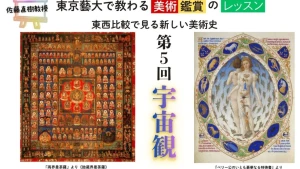
 Professor Naoki Sato compares Western and Eastern cosmologies using the 'Zodiac and Anatomy' and the 'Garbhadhatu Mandala' to explain their fundamental differences.
Summary
In collaboration with Art Exhibition NAVI and the monthly magazine 'Chuo Koron', this series features Professor Naoki Sato from the Faculty of Fine Arts at Tokyo University of the Arts, titled 'Lessons in Art Appreciation at Tokyo University of the Arts: A New Art History Viewed Through East-West Comparison'. The fifth installment explores the theme of 'Cosmology'. To compare the distinct ways Western and Eastern cultures perceive the universe, the article analyzes the 'Zodiac and Anatomy' from the 'Très Riches Heures du Duc de Berry' and the 'Garbhadhatu Mandala' preserved at Toji Temple in Kyoto. The Western work illustrates the concept of 'Human Body = Microcosm', reflecting a worldview where celestial movements directly influence human physiology and temperament. In contrast, the Eastern Mandala centers on Vairocana, representing the ultimate truth of the universe, and depicts a structure where all elements are interconnected, suggesting that humans are merely one part of the cosmos. This comparison highlights the fundamental difference between the Western approach, which seeks to understand celestial bodies in relation to humanity, and the Eastern approach, which situates humanity within the grand order of the universe.
(Source:美術展ナビ)