Episode 9:
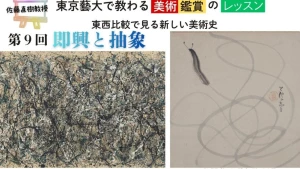
 Comparing Nagasawa Raisetsu's "Slug Print" with Jackson Pollock's abstract painting, exploring Eastern and Western differences in "improvisation" and "abstraction."
Summary
This article is the 9th installment of an art appreciation column by Professor Naoki Sato of Tokyo University of the Arts, themed "Improvisation and Abstraction." It compares the Edo-period work "Slug Print" by Nagasawa Raisetsu with the 20th-century American painting "One: Number 31, 1950" by Jackson Pollock.
"Slug Print" is an improvised piece depicting a slug's trail with a single stroke of ink, featuring a mysterious beauty and Zen-like depth within its negative space. In contrast, Pollock used "action painting," dripping paint while moving his body, to fill the entire canvas with dynamic, abstract lines.
The crucial commonality is that both works incorporate "accident," which the artist cannot fully control. Raisetsu accepts a natural trajectory, suggesting an Eastern naturalistic philosophy. Pollock transforms accident into a creative act, embodying Western "anthropocentrism." Through this comparison, the article reveals how Eastern and Western artists perceive improvisation and abstraction within different philosophical contexts.
(Source:美術展ナビ)