Yayoi Kusama's Last Exhibition: Tracing Over 70 Years of Creation in Amsterdam
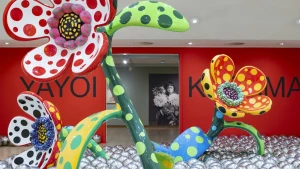
 A major Yayoi Kusama retrospective opened in Amsterdam, showcasing over 70 years of her creative work.
Summary
On September 11, 2025, the Stedelijk Museum Amsterdam opened a major retrospective of Yayoi Kusama, titled "Yayoi Kusama." Following Kusama's death at age 97 on August 14, just before the opening, the museum announced the exhibition as a memorial celebrating her over 70 years of creative activity and life; it became the last exhibition she was involved in. The exhibition is a collaboration with the Fondation Beyeler in Basel, Switzerland, and the Museum Ludwig in Cologne, Germany, traveling to three venues. For the Amsterdam opening, the museum decorated its facade with colorful polka dots. The exhibition focuses on Kusama's life and work from childhood to her final years, including her time in the Netherlands, arranged roughly chronologically and featuring paintings, sculptures, installations, poetry, novels, fashion, and happenings, based on extensive research and archives. Curator Leontine Coelewij said at the opening press conference, "What emerges through the exhibition is the continuity of her creation throughout her life. Ideas that sprouted in her early works are carried through to her latest works, changing form." Born in Matsumoto, Nagano Prefecture, in 1929, Kusama suffered from anxiety and hallucinations from childhood. Around age 10, she experienced hallucinations of polka dots and nets covering her vision, and began drawing as a way to cope with fear. The exhibition begins with early works, including a portrait of her mother covered in polka dots, works from the late 1940s when she studied Japanese painting at the Kyoto Municipal School of Arts and Crafts, and abstract works from the 1950s. It also displays correspondence with Georgia O'Keeffe (1887–1986), which encouraged Kusama's move to the United States in 1957. The exhibition space changes dramatically when it moves to America, with large-scale works in a high-ceilinged room symbolizing her artistic liberation in New York. A key early work is "Pacific Ocean" (1958), depicting the expanse of the Pacific she saw from a plane window, and it marks the beginning of her infinity nets. In 1959, Kusama held her first solo exhibition in New York, presenting works including "Untitled (No. White A.Z.)" (1958–59), later known as part of her "Infinity Nets" series, featuring huge canvases covered in countless small loops forming net-like patterns that create an optical illusion. Critic Donald Judd, later a leading Minimalist, wrote in Art News that Kusama was an "original painter" whose five huge white paintings were "strong, advanced in concept, and realized." He noted that the effect is "complex and simple at the same time" and that the expression "transcends the question of whether it is Oriental or American." This testifies to the striking impression Kusama's work made on the New York art scene at the time.
(Source:美術手帖)